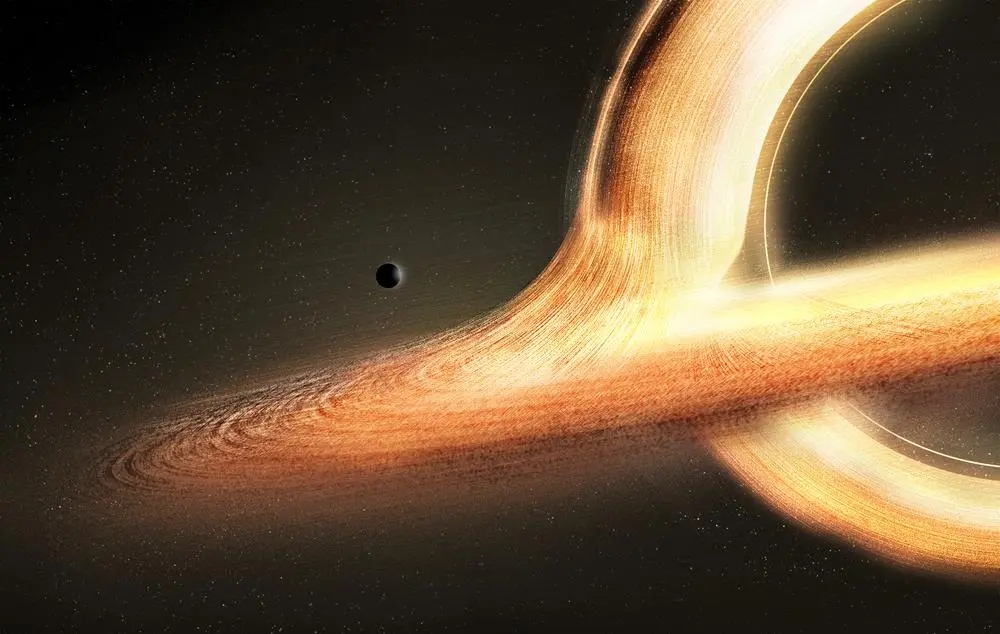
Black holes, once considered mysterious cosmic voids, are now at the forefront of modern astrophysics. Thanks to rapid advancements in space telescopes, gravitational wave detectors, and computational modeling, recent black hole research is transforming how scientists understand the universe. From observing black hole collisions to uncovering their role in galaxy formation, these discoveries are reshaping long-held theories about space and time.
Sharper Images of the Invisible
One of the most remarkable breakthroughs in black hole research has been the ability to capture increasingly detailed images of these invisible giants. Using global networks of radio telescopes, scientists have refined images of supermassive black holes, revealing clearer structures around their event horizons. These observations help confirm predictions made by Einstein’s theory of general relativity while also raising new questions about extreme gravity.
Gravitational Waves Unlock Cosmic Secrets
The detection of gravitational waves has opened an entirely new window into black hole research. When black holes collide and merge, they send ripples through spacetime that can be detected on Earth. Recent observations have provided insights into black hole masses, spin rates, and formation histories, helping scientists understand how these objects evolve over billions of years.
Black Holes and Galaxy Evolution
New studies suggest that black holes play a central role in shaping galaxies. Supermassive black holes at the centers of galaxies influence star formation by releasing powerful jets and radiation. These energetic outflows can either trigger or suppress the birth of new stars, directly impacting the growth and structure of galaxies across the universe.
Unexpected Black Hole Behavior
Recent research has also revealed surprising behavior from black holes. Scientists have observed unusual flares, shifting jets, and rapid changes in brightness around accretion disks—the swirling matter falling into black holes. These findings challenge existing models and suggest that black holes are far more dynamic than previously thought.
The Role of Advanced Technology
Next-generation observatories and space missions are accelerating black hole research. Advanced telescopes are allowing astronomers to study black holes across different wavelengths, from radio waves to X-rays. Artificial intelligence and machine learning are also being used to analyze massive datasets, helping researchers identify patterns and anomalies faster than ever before.
What This Means for Our Understanding of the Universe
These discoveries go beyond black holes themselves. They provide critical insights into fundamental physics, including gravity, spacetime, and the origins of the universe. By studying black holes, scientists can test the limits of known laws of physics and explore what happens under the most extreme conditions imaginable.
Conclusion
Black hole research is entering a golden age. With each new discovery, scientists move closer to understanding not only these mysterious objects but also the broader workings of the universe. As technology continues to advance, black holes will remain key to unlocking some of the deepest cosmic mysteries—reshaping our view of space, time, and reality itself.